
At Halewood Academy, we use our core values to guide our decisions about assessment. We believe that:
All assessments should be carefully designed to ensure that they support and develop the key knowledge and skills required for success.
Assessment should be used to inform the teacher about students’ learning as well as to identify gaps in knowledge, skills and understanding.
Information from Assessments should be used to plan lessons and provide students with feedback on how to accelerate learning.
Greater emphasis should be placed on formative assessment however, information from such assessments can be used summatively.
Assessments in class are in the form of Green Zones, which assess students on the learning from the lesson, or last topic. Written Green Zones should be completed under exam-style conditions and these are timed where possible. These are then marked by the class teacher and students are provided with feedback to accelerate learning.
Our Assessment model should have consistent principles, to be used across subjects, but the flexibility to be suitable for all subjects.
Assessment should improve students’ learning - not just measure their learning.
Providing feedback to students should not be burdensome for staff.
In Years 10 and 11, GCSE target grades have been based on information from how students have performed in their subjects in KS3 (Year 10) and KS3/Y10 (Year 11) as due to Covid-19, students in the current Year 10 and 11 did not sit SATs in Primary School. ALL Subject Leaders have completed a thorough review of target gradesfor each individual student in Year 10 and 11 to ensure they are both aspirational and appropriate, based on the level of ability in that subject. These target grades were shared at the end of the academic year 2023-2024 and will be shared with all students at the start of September 2024.
In years 7 - 9 we use prior attainment from Key Stage 2 and some practical subjects may use a robust baseline. Each student is then assigned a progress pathway that is relative to each child’s ability so we, your child and yourselves can monitor their progress. These targets are then reviewed at the end of the year to ensure they are still aspirational and appropriate.
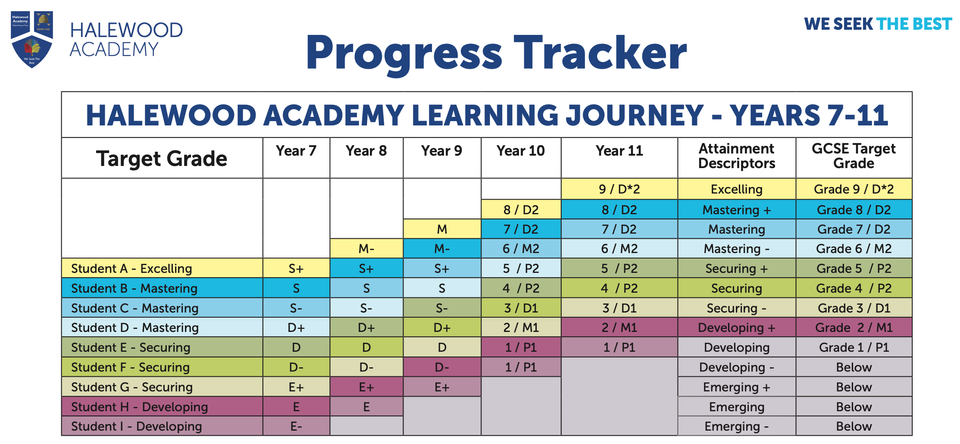
This is simply a guide and pathways could be subject to change based on each child’s achievements throughout their five years. As a school, we encourage all students to give their best and there should be no limitation on their achievements. This is a benchmark and if a child works hard and listens to feedback from their teacher, they can exceed expectation.
Progress Reports – KS3 (Years 7-9)
Student’s will receive 3 reports per year providing a full overview of where your child is currently working as well as providing an overview of the progress they are making.
In addition, there will be a focus on RACER points, attendance, behaviour and attitude to learning.
Students will receive a written comment that reports progress in words for each subject. The class teacher will be able to choose from one of the 5 progress comments (shown below).
This is especially important in Years 7-9 where the information reported will be heavily based on the on-going learning in class, including green zones so that knowledge and skills can be built upon and to see how this compares to their targets and their potential.
Progress Reports – KS4 (Years 10 and 11)
Assessment of key knowledge, skills and understanding will continue to be reported numerically and accompanied with a written comment to report progress in words.
The class teacher will be able to choose from the 5 progress comments (indicated above) based on the expected GCSE flight path for each subject.
It is important to remember that completing a section of an exam paper is not the same as completing the paper in its entirety; whilst students may have performed well on a smaller element, the grade reported has to consider these pieces in relation to the whole GCSE.
In Y10, the grade reported will likely be a distance away from the Target – this is to be expected, especially at the start of the GCSE course where there is still content, knowledge and skills to be covered.
Example of the Year 11 P2S1 Grade Card is below:
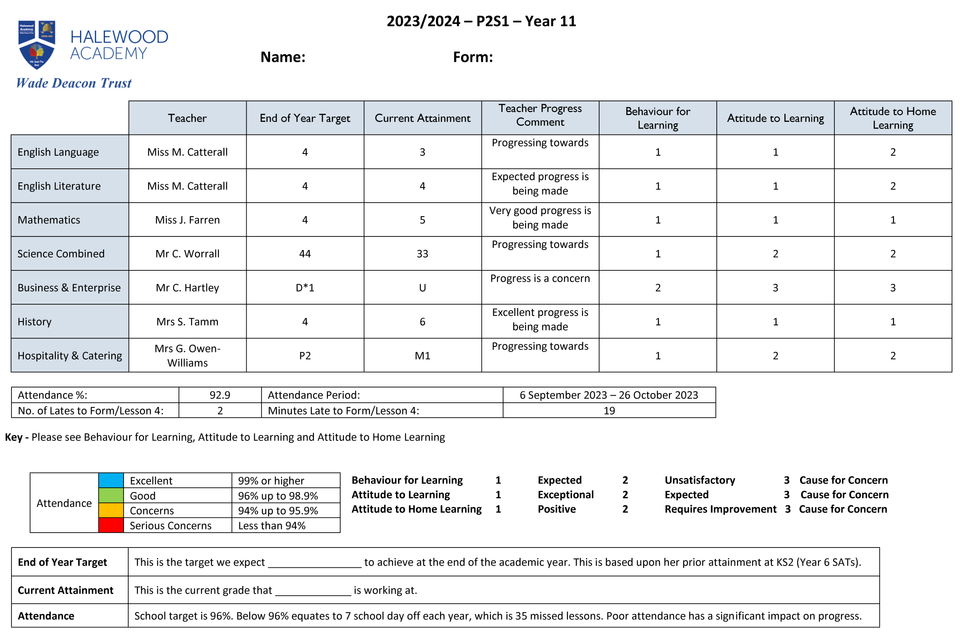
Examples of Year 9, 10 and 11 P2S1 Grade Card and Report below:
Example of Year 10 P2S1 Grade Card
Example of Year 11 P2S1 Grade Card
Progress Reports
In Years 7 - 9, your child will receive 3 reports per year providing a full overview of where your child is currently working as well as providing an overview of the progress they are making.In addition, there will be a focus on RACER points, attendance, behaviour and attitude to learning.
In years 7 - 9, students will receive a written comment that reports progress in words for each subject.This is especially important in Years 7-9 where the information reported will be heavily based on the on-going learning in class, including green zones so that knowledge and skills can be built upon over the five-year journey.
In Years 10 and 11, assessment of key knowledge, skills and understanding that have been assessed will continue to be reported numerically and accompanied with a written comment to report progress in words.
Learning Journey
Is a visual representation of the subject content taught over five years. These will be made available by class teachers for Students.
This site uses cookies that enable us to make improvements, provide relevant content, and for analytics purposes. For more details, see our Cookie Policy. By clicking Accept, you consent to our use of cookies.